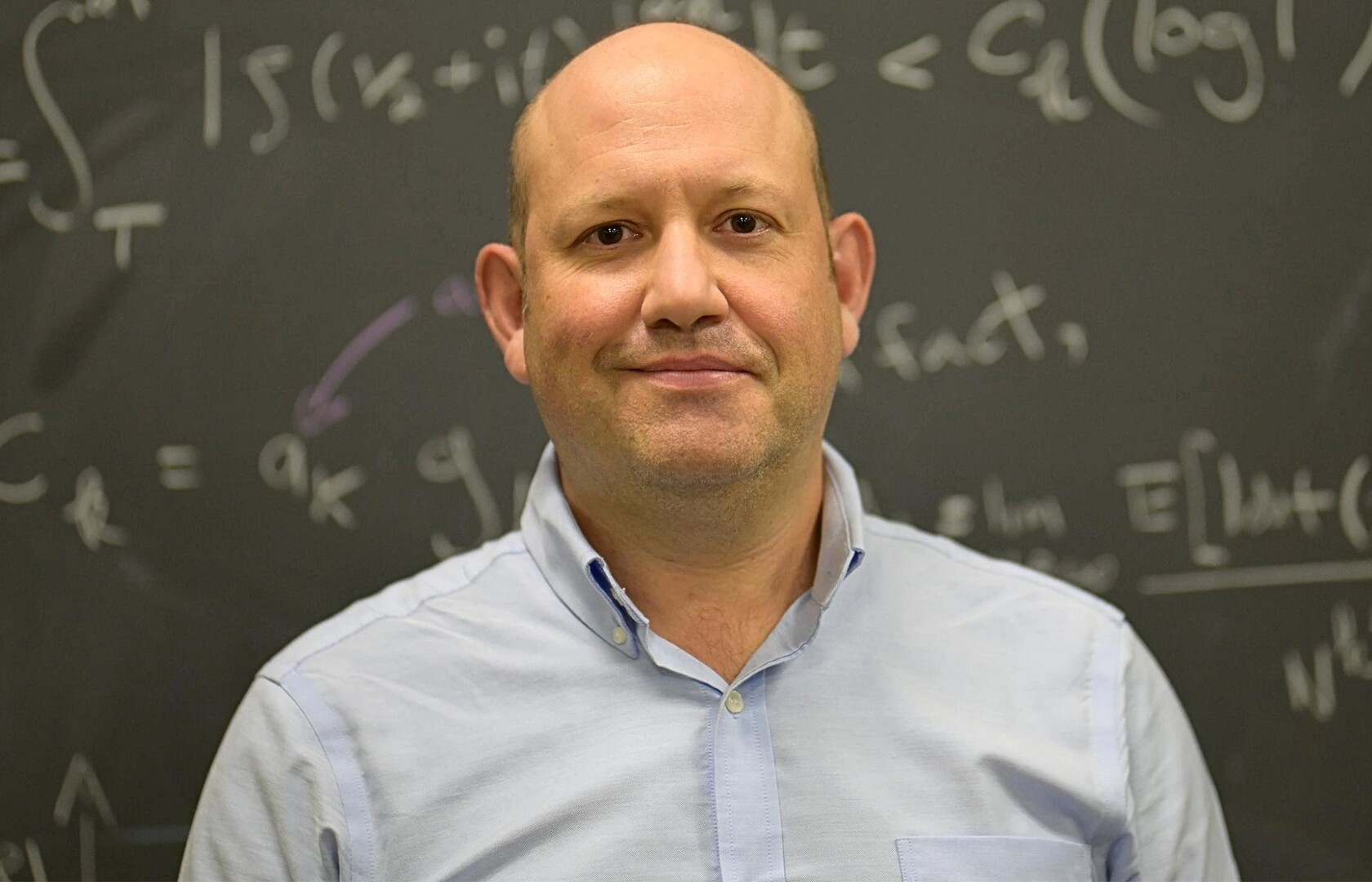
CUNY Professor Louis-Pierre Arguin
Photo credit: Alex Irklievski
CUNY mathematics professor Louis-Pierre Arguin, a principal investigator in the Simons Collaboration on Universal Statistics in Number Theory.
CUNY mathematics professor Louis-Pierre Arguin has been awarded $560,000 over four years as a principal investigator in an international research collaboration exploring some of the most challenging questions in number theory. Arguin, who is affiliated with the CUNY Graduate Center and Baruch College, will participate in the Simons Collaboration on Universal Statistics in Number Theory. The project brings together researchers using probability and statistical physics to investigate patterns involving prime numbers, the Riemann zeta function and other mathematical problems. The funding will also support a postdoctoral researcher who will interact with doctoral students in the Graduate Center's Mathematics Ph.D. program, connecting CUNY students with a broader international network of mathematics researchers.
Graduate Center Professor Tackles Prime Number Mysteries in Simons Project
Professor Louis-Pierre Arguin has been named a principal investigator in the Simons Collaboration on Universal Statistics in Number Theory, a major international effort to uncover hidden patterns in prime numbers and tackle some of mathematics’ most enduring mysteries.
Professor Louis-Pierre Arguin (GC/Baruch, Mathematics) has been named a principal investigator in the Simons Collaboration on Universal Statistics in Number Theory, an ambitious international project that aims to reveal new connections in number theory and make progress on questions that have challenged mathematicians for generations.
Arguin will receive $560,000 over four years for his part of the project. Simons Collaborations in Mathematics and the Physical Sciences, funded by the Simons Foundation International, bring together leading researchers to address questions of fundamental scientific importance.
At the center of the project are the natural numbers — 1, 2, 3, 4 and so on — which appear simple but contain patterns that have puzzled mathematicians for centuries. Prime numbers, such as 2, 3, 5 and 7, are a famous example: Mathematicians know there are infinitely many, but cannot predict exactly where the next one will appear. They also still do not know whether there are infinitely many “twin primes,” pairs such as 11 and 13 that are separated by two. Mysteries like these reveal how numbers that follow exact rules can nevertheless behave in ways that seem random.
Arguin studies probability, an area of mathematics concerned with randomness and uncertainty. The new collaboration will use ideas from probability and statistical physics to better understand number theory, including the Riemann zeta function, a mathematical object closely connected to the distribution of prime numbers. By bringing these different areas together, researchers hope to find patterns that traditional approaches have not been able to reveal.
The project will also create opportunities for Graduate Center doctoral students. Arguin’s grant will support a postdoctoral researcher who will work with and exchange ideas with students in the Mathematics Ph.D. program, giving them greater access to research connected to an international network of leading mathematicians.
Arguin credits the Graduate Center’s collaborative environment with helping such research flourish.
“The faculty and the students form a vibrant community,” he said. “There are always people discussing mathematics in the common room.”
He described the Graduate Center as “an oasis where people can explore the beauty and the complexity in mathematics at a human level.”
Source: CUNY Graduate Center