Governor Hochul Announces 2.5 Million More New York Households Are Eli
Susan Watts/Office of Governor Kathy Hochul
Governor Hochul Announces 2.5 Million More New York Households Are Eligible to Get Discounts on Utility Bills
More New York City households can now qualify for monthly discounts on electricity and gas bills following an expansion of New York State’s Energy Affordability Program. The updated eligibility rules extend assistance beyond households participating in certain public-benefit programs to include additional residents based on income, significantly widening the pool of potential recipients. For Con Edison and National Grid customers in New York City, qualifying income limits reach $113,400 for a one-person household, $162,000 for a four-person household and $213,900 for a household of eight. Discounts vary according to income and can provide hundreds of dollars in annual savings, with the state estimating some households could save as much as $500 per year. New York is launching a broader outreach campaign to identify eligible residents and encourage those who are not automatically enrolled to apply online.
Governor Hochul Announces 2.5 Million More New York Households Are Eligible to Get Discounts on Utility Bills
Governor Hochul today launched a new statewide enrollment drive to help millions more New Yorkers get a monthly discount on their utility bills through the State’s Energy Affordability Program (EAP). While 1 million households statewide are already enrolled in the EAP, the State estimates that approximately 2.5 million more households are eligible to enroll for monthly discounts – including many that are now eligible due to Governor Hochul’s expansion of program eligibility. Depending on household income, the EAP can help New Yorkers save up to hundreds of dollars per year on utility costs, with discounts set to make a typical utility bill less than six percent of household income.
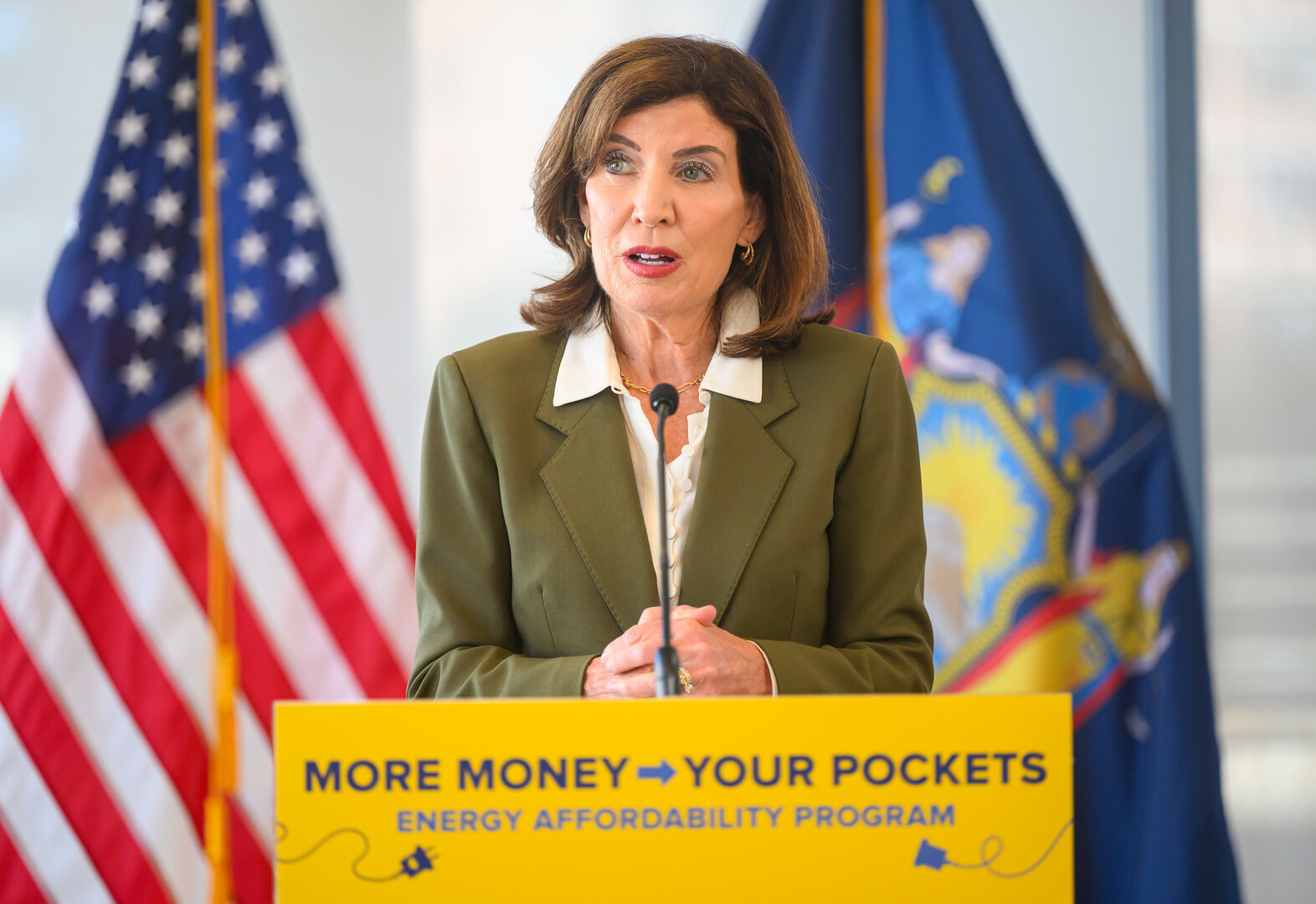
"As Washington Republicans keep driving up the cost of energy, gas and groceries, I’ll never stop working to help New Yorkers keep more money in their pockets,” Governor Hochul said. “That’s why I expanded access to our Energy Affordability Program – a move that will save residents across the state up to $500 annually on their energy bills. Right now, 2.5 million eligible New Yorkers are leaving money on the table and I'm on a mission to help keep the lights on and costs down by launching an all-of-government push to get them enrolled in this money saving program. I encourage New Yorkers to take advantage of this opportunity by visiting NY.gov/EAP today."
New York’s Energy Affordability Program (EAP) and Expanded Eligibility
Up to half of all New York State households are eligible to receive monthly utility discounts through the EAP. While some households are automatically enrolled based on their participation in other programs, many other households can enroll by applying online via ny.gov/EAP. Households can save up to hundreds of dollars per year on their utility costs with EAP discounts – and the size of the EAP discount is based on household income.
Households are automatically enrolled in the EAP if they are currently enrolled in the Home Energy Assistance Program or the Public Assistance (i.e., Temporary Assistance), which are administered by the Office of Temporary Disability Assistance (OTDA).
Households are also eligible for EAP discounts if they are currently enrolled in numerous other programs. However, these households are not automatically enrolled in the EAP due to customer privacy restrictions that prevent automatic enrollment. These households can self-enroll to receive EAP discounts by applying online. This applies to households currently enrolled in:
- Supplemental Nutrition Assistance Program (SNAP)
- Medicaid
- Veterans’ Disability or Survivors Pension
- Supplemental Security Income
- Lifeline Telephone Service Program
- Federal Public Housing Assistance
- Utility Guarantee
- Direct Vendor programs
- Temporary Assistance for Needy Families (TANF)
- Safety Net Assistance
- Bureau of Indian Affairs General Assistance
- Head Start
- Tribal TANF
- Food Distribution Program on Indian Reservations
Effective January 2026, Governor Hochul’s administration also expanded eligibility to include New York households that are below the state median income, or below area median income in New York City, Westchester, and Nassau County. These households can also enroll by applying online via ny.gov/EAP.
"As Washington Republicans keep driving up the cost of energy, gas and groceries, I’ll never stop working to help New Yorkers keep more money in their pockets,”
New EAP Enrollment Drive
Governor Hochul has directed the Department of Public Service to begin a new enrollment push to help more New Yorkers sign up for EAP discounts over the coming weeks and months.
As part of the enrollment drive, the Department of Public Service will do targeted digital advertising and work with other state agencies to use direct mail, email, and/or texts to inform more New Yorkers about EAP eligibility and enrollment information.
Social services agencies will cross-reference customers enrolling in other programs to EAP, agencies will partner with community organizations to attend in-person enrollment events, and utilities will directly inform customers on the enrollment process.
State agencies dealing with the public will also promote the program on their digital boards inside their public-facing offices.
Assemblymember Grace Lee said, “New York families are already stretched thin, and harmful federal policies are driving energy costs even higher. I thank Governor Hochul for making sure more households can access the relief they deserve. Half of all New York households may qualify, and I encourage every eligible New Yorker to visit ny.gov/eap and enroll.”
Governor Hochul’s Energy Affordability Agenda
Throughout her time in office, Governor Hochul has targeted relief for energy ratepayers. Just this week, the Governor announced that $1 billion in energy rebate checks will go out to 8.2 million eligible households beginning September 21.
Post-COVID, the Governor announced $1.17 billion in one-time funding to allow nearly half a million residential customers and 56,000 small businesses to pay off unaffordable past utility bills, the largest utility customer financial assistance program in state history.
Since taking office in 2021, Governor Hochul has prioritized making life easier for New Yorkers. That includes more than $6.6 billion (not including the $1 billion energy rebate checks being sent out this fall) that has been provided to participating households in direct utility bill relief, and an additional $1.4 billion to support residential weatherization, energy efficiency and renewable energy projects that will help lower energy usage and bills for participating households.
This year, Governor Hochul also put in place an Energy Affordability Agenda that puts New York families ahead of big energy companies to help address rising utility rates. At the heart of this effort to modernize the State’s approach to regulating utilities is a commitment to ensuring energy remains affordable. Energy profits will be tied to a company’s ability to perform where it matters most: people’s wallets. Utilities will be prohibited from passing the costs of lobbying, glossy PR campaigns, political donations, and luxury travel to New York ratepayers. Utility CEOs will have their salaries benchmarked to achieving energy affordability goals set by the Public Service Commission (PSC). And if a utility makes excess profit, that money will be returned to ratepayers.
The Governor’s Ratepayer Protection Plan will:
- Stop disruptive price hikes before they take effect in the first place by demanding unprecedented fiscal discipline and transparency from utility companies. When requesting a rate increase, utilities will have to prove that their capital projects are absolutely necessary and that they’ve left no stone unturned in the pursuit of zero-emission options. They’ll also have to present a budget-constrained option that keeps their operating costs below the rate of inflation.
- Ensure a fair fight by requiring 14 months to examine rate requests by utility companies and the PSC will be able to set multi-year rate cases when they make sense for consumers. The State’s regulators will also heavily scrutinize the fees that utilities run up during the process of determining new rates. The goal is to ensure customers aren’t shouldering any costs associated with utility rate cases that aren’t legally required.
- Require the establishment of a new energy affordability index that will expose the true impact of utility rates on everyday New Yorkers, benchmarking utility performance here against those in the rest of the nation. Going forward, utilities will be required to demonstrate exactly how any proposed rate hike will impact this index — and if a rate case pushes the average household energy burden above 6 percent, the State will be able to deploy an independent Affordability Monitor directly into the utility’s boardroom.
Additionally, the FY27 enacted budget establishes a RATES Commission to combat rising utility bills. New Yorkers are facing real pressure from the rising costs of energy, and addressing these price spikes requires a clear, independent examination of how energy prices and costs are passed onto consumers. The newly established RATES Commission will bring together consumer advocates and energy experts to investigate the root causes of surging utility bills, evaluate utility profits, and review energy market designs.
Source: New York State Governor's Office