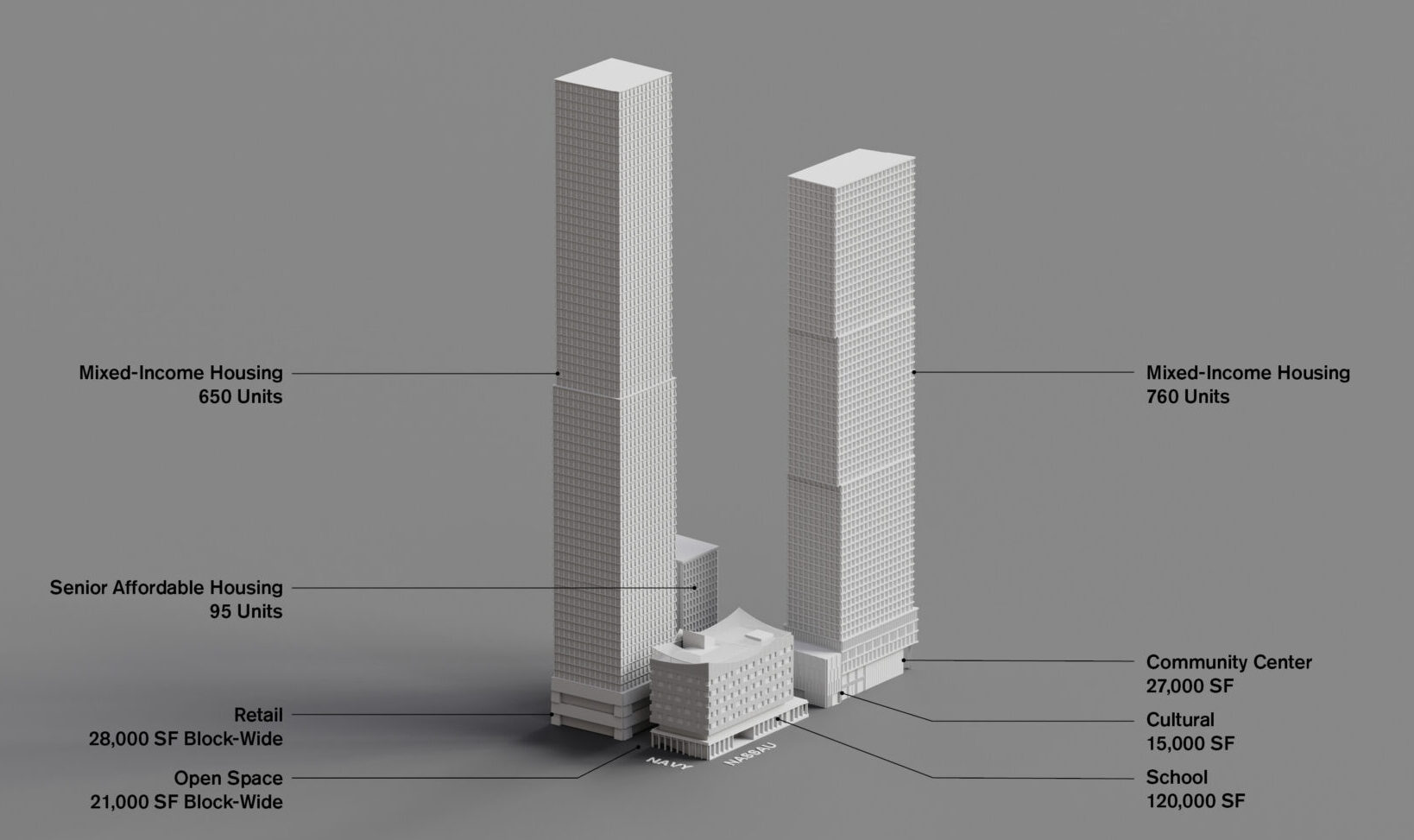
Development at 240 Nassau Street in Brooklyn Rendering
Alloy Development
Development at 240 Nassau Street in Brooklyn Rendering
As part of NYC Newswire’s Voices of NYC series, Fort Greene resident and urbanist Sam Blackwell weighs in on the proposed 240 Nassau Street development and its potential impact on the surrounding Brooklyn community. Blackwell argues that the project’s two towers, approximately 1,500 apartments and large share of market-rate housing are out of scale with nearby Ingersoll, Whitman and Farragut Houses. While acknowledging the need for new housing, a public school and community amenities, he questions whether those benefits justify the size and density being proposed. In this opinion piece, Blackwell examines the development through the lens of affordability, gentrification and neighborhood character, arguing that 240 Nassau Street should be reconsidered before receiving final approval.
Out of Scale and Out of Touch: Why 240 Nassau Street Fails Our Community
By Sam Blackwell, Urbanist and Fort Greene Resident
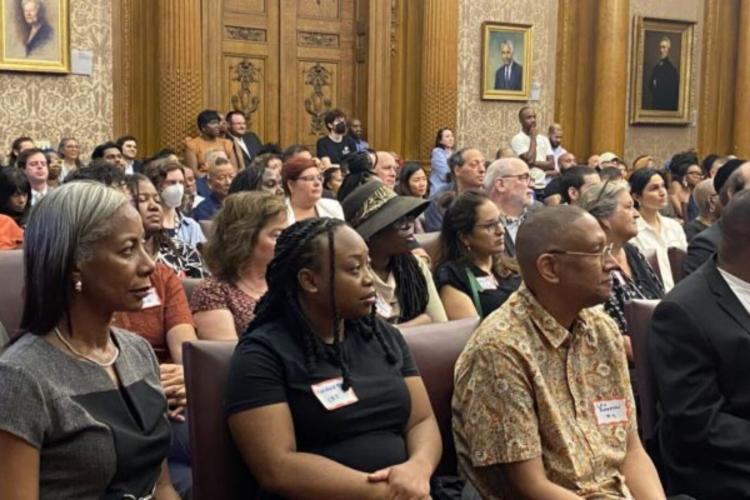
I stood up at the public hearing this week to oppose the 240 Nassau Street project, and I said it plainly: you can't be both stupid and desperate. This project is both.
Let me start with the numbers, because the developers put them out themselves, and the numbers tell the story better than any rendering they've produced.
Alloy Development, together with the NYC Educational Construction Fund and GFB Development, wants to build two towers at 240 Nassau Street: one at 63 stories, the other at 73 stories. Stand in front of Ingersoll Houses, Whitman Houses, or Farragut Houses — the public housing communities that border this site — and look up. Ingersoll tops out at 11 stories. Whitman tops out at 13. Farragut tops out at 14. The tallest building in our neighborhood right now is a third the height of the shorter tower these developers want to build. The taller one is five to six times the height of everything around it.
That is not infill. That is not "fitting into the neighborhood." That is a spaceship landing in Fort Greene.
And the density tells the same story. Farragut Houses — 10 buildings, spread across several acres of land — holds 1,390 apartments. 240 Nassau wants to pack roughly 1,500 units onto a single site. One project, one footprint, more homes than the entirety of Farragut Houses. That's not development. That's a stress test on infrastructure, schools, transit, and sewage systems that were never built for this kind of density, dropped onto three blocks that already carry more than their share of this city's public housing.
Now let's talk about what those 1,500 units actually are. Of that total, roughly 300 are set aside as affordable — about 200 for the general community and 100 in a separate building for seniors. That leaves roughly 1,200 units — 80 percent of this entire project — at market rate. So when Alloy stands up and calls this "community-driven" and "much-needed affordable housing," ask yourself: needed by whom? A project this size didn't have to be this tall to deliver 300 affordable units and a school. They chose to build 1,200 market-rate apartments in towers that dwarf everything around them, and they're using the affordable units and the school as the price of admission to get it approved.
That's the "desperate" part — desperate to extract every possible square foot of market-rate value out of this site before the neighborhood, or anyone paying attention, can stop them.
And here's the "stupid" part: they did this in a community that is already living through what I call hyper-gentrification. I coined that term to describe exactly this pattern: a community transformed using public money and a faulty Area Median Income calculation, dressed up in an 80-20 formula — 80 percent market rate, 20 percent affordable — where the "affordable" number is pegged to an AMI that has nothing to do with what the people actually living in that community earn. Look at 240 Nassau's own numbers: roughly 1,200 market-rate units against 300 affordable. That's the 80-20 formula, playing out in real time, on public land, next to public housing. You do not solve hyper-gentrification by building the textbook example of it directly across the street from the residents most vulnerable to it. That isn't tone-deaf. That's contempt dressed up as community partnership.
We are not against development. We are not against affordable housing, a new school, or a cultural center — all things this neighborhood genuinely needs. What we are against is scale that has nothing to do with need and everything to do with maximizing profit on land next to communities that have historically had the least power to say no.
240 Nassau Street, as proposed, is out of scale with everything around it, and out of touch with what this community actually asked for. The developers have the data. They published the renderings. They know exactly how tall these towers are next to Ingersoll, Whitman, and Farragut. They built it this big anyway.
You can't be both stupid and desperate. This project is both. It should not be approved as proposed.
Sam Blackwell is an urbanist and Fort Greene resident who spoke in opposition to 240 Nassau Street at this week's public hearing on September 16, 2026.
Source: Sam Blackwell, Urbanist and Fort Greene Resident