NYPD Facial Recognition Technology Under Review as NYC Investigation D
Frame Stock Footage
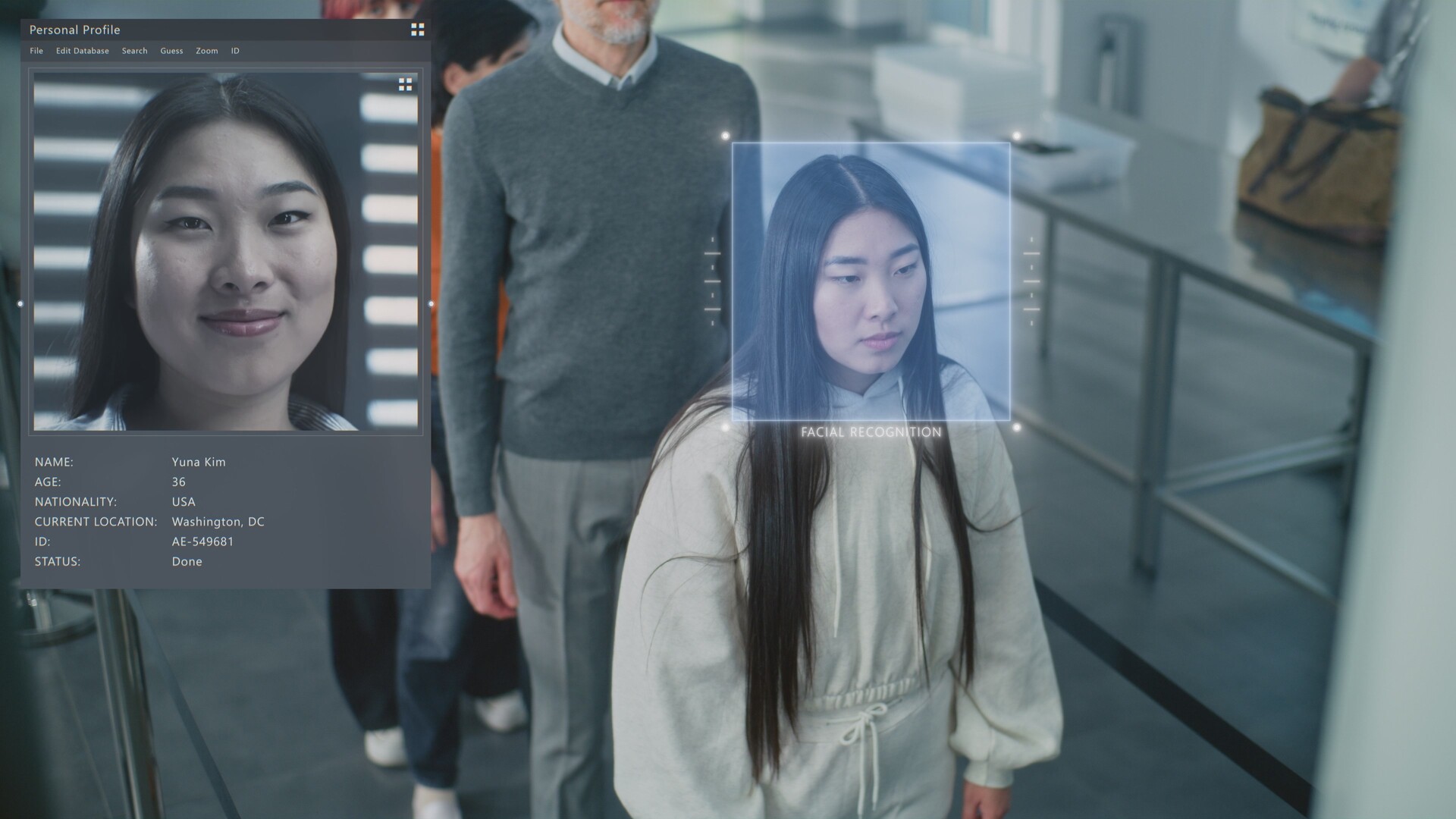
Security Checkpoint: Queue of Diverse Passengers Passing Biometric AI Face Scanning at Border Control in Airport Terminal. Advanced Facial Recognition Technology. People Screening for Boarding Flight.
New York City’s Department of Investigation has released an assessment of the NYPD’s compliance with the Public Oversight of Surveillance Technology (POST) Act, focusing on the department’s use of facial recognition technology. The review found that the NYPD largely complies with the POST Act but identified areas requiring stronger transparency, documentation and operational controls, including instances in which the department violated its own policy or did not comply with recently enacted legislation. OIG-NYPD issued 17 recommendations: nine address alignment with POST Act requirements, while eight focus on improving internal processes and coordination with outside entities. Recommendations include clearer disclosure, image-modification logs, supervisory review, investigator training and annual audits.
DOI’S OFFICE OF THE INSPECTOR GENERAL FOR THE NYPD ISSUES REPORT ASSESSING THE NYPD’S COMPLIANCE WITH THE PUBLIC OVERSIGHT OF SURVEILLANCE TECHNOLOGY (POST) ACT FOCUSING ON FACIAL RECOGNITION TECHNOLOGY POLICIES AND ISSUING 17 RECOMMENDATIONS
Nadia I. Shihata, Commissioner of the New York City Department of Investigation (“DOI”), issued the following report from DOI’s Office of the Inspector General for the New York City Police Department (“OIG-NYPD”) concerning the New York City Police Department’s (“NYPD”) compliance with the Public Oversight of Surveillance Technology (“POST”) Act. For this Report, the fourth published pursuant to the POST Act,1 DOI’s OIG-NYPD reviewed NYPD’s Impact and Use Policy (“IUP”) for facial recognition technology, a topic addressed in its inaugural POST Act report in 2022. In August 2025, OIG-NYPD decided to focus on the issue after receiving a letter from the Legal Aid Society requesting an investigation of alleged violations of the NYPD’s facial recognition IUP. Following its Post Act review, DOI’s OIG-NYPD issued 17 recommendations to the NYPD, finding that while the NYPD largely complies with the POST Act with respect to its facial recognition policies, there are a series of changes and refinements that the NYPD should make to its procedures to further transparency interests and to allow for more accurate and controlled use of facial recognition technology, including modifications to address instances where the NYPD violated its own policy and failed to comply with recently enacted legislation. The Report follows this release and can be found at this link: OIG-NYPD Reports
DOI Commissioner Nadia I. Shihata said, “In examining the NYPD’s Facial Recognition Impact and Use Policy, DOI’s OIG-NYPD found there is room for the NYPD to strengthen transparency and control of the Department’s use of this significant surveillance technology. While surveillance technology can be an important tool relied on by law enforcement, its use must be accompanied by public transparency, policies, and procedures to limit the risk of misuse and protect civil rights. The 17 recommendations that DOI’s OIGNYPD has issued as a result of this examination will help the NYPD achieve this goal and provide the public with greater insight into the use of this technology.”
OIG-NYPD first addressed the NYPD’s use of facial recognition technology in its 2022 inaugural POST Act report, which made two recommendations regarding the NYPD’s use of facial recognition technology; specifically, that (1) the NYPD adopt guidelines outlining how and when the images input into facial recognition programs could be modified; and (2) the NYPD periodically audit its compliance with its own facial recognition policies. While the NYPD rejected both recommendations, they were subsequently enacted legislatively by the New York City Council in 2025, requiring the NYPD to implement the changes either immediately or as effective on September 1, 2025.
The three previous Post Act reports by DOI’s OIG-NYPD
• An Assessment of NYPD's Response to the POST Act, November 3, 2022
• An Assessment of NYPD's Compliance with the POST Act, May 30, 2024
• An Assessment of NYPD’s Compliance with the POST Act, December 18, 2024 2
The NYPD has two policy and procedure documents related to the use of facial recognition technology: (1) its Facial Recognition Impact and Use Policy, which was most recently updated in February 2026 and includes several addenda; and (2) Patrol Guide § 212-129, titled “Facial Recognition Technology,” which has been effective since December 2, 2022, and sets forth the NYPD’s internal procedures for the use of facial recognition technology.
The POST Act requires DOI to prepare annual audits of the NYPD’s surveillance technology IUPs, including: (1) assessment of the NYPD’s compliance with the terms of its own policies; (2) descriptions of any known or reasonably suspected violations of the policies; and (3) recommendations on revisions to the IUPs. To conduct this audit, OIG-NYPD performed a section-by-section analysis of the most recent version of the Facial Recognition IUP, published in February 2026. OIG-NYPD then compared the Facial Recognition IUP against the NYPD’s internal procedures and practices regarding the use of facial recognition technology embodied in a provision of the NYPD’s Patrol Guide, as described during interviews of NYPD officials about its use of facial recognition technology, and as reflected in other information provided by the NYPD. Finally, OIG-NYPD further informed its findings through a review of publicly available news and research articles regarding facial recognition technology.
This Report offers the NYPD 17 recommendations concerning its Facial Recognition IUP that will improve the NYPD’s compliance, particularly with recent amendments to the POST Act passed in 2025. Nine recommendations propose updates to the IUP to ensure alignment with the POST Act. The remaining eight recommendations focus on enhancing the operational efficacy of the NYPD’s facial recognition processes, both internally and in its coordination with outside entities. Notably, while the time period of this Report covers data, information, and policies in effect through 2025, OIG-NYPD became aware of changes to certain policies and procedures discussed herein only after the NYPD received the Report for comment. OIG-NYPD has included these updates in the Report to avoid redundancy in its recommendations, ensuring they remain relevant.
The Recommendations OIG-NYPD issued to NYPD are:
Recommendation #1: The NYPD should amend the Facial Recognition Impact and Use Policy to include the names of the three facial recognition products in use at the NYPD.
Recommendation #2: The NYPD should amend the Facial Recognition Impact and Use Policy to enumerate the photo repositories associated with each of the facial recognition products it uses, as well as to identify specifically from where the photographs contained in the photo repositories are obtained.
Recommendation #3: The NYPD should amend its Facial Recognition Impact and Use Policy to specifically identify which Bureaus have access to facial recognition technology, what those Bureaus do, and who they serve.
Recommendation #4: The NYPD should update Patrol Guide 212-129 to instruct personnel to request facial recognition analysis only from the authorized unit within their assigned Bureau.
Recommendation #5: The NYPD should ensure that facial recognition analysis logs in both the Enterprise Case Management System and the Intelligence Division Case Management System are standardized to capture consistent and accurate data collection across all entries.
Recommendation #6: The NYPD should update Patrol Guide 212-129 to memorialize the Facial Recognition Impact and Use Policy’s guidelines regarding acceptable image enhancement techniques.
Recommendation #7: The NYPD should establish and document an authorization process requiring facial recognition investigators to obtain permission from the Chief of Detectives or Chief of Intelligence (depending on the relevant Bureau the facial recognition investigator is assigned to) prior to editing probe images beyond standard parameters.
Recommendation #8: The NYPD should implement a mandatory documentation process to log all probe image modifications in compliance with the 2025 POST Act amendments. 3
Recommendation #9: The NYPD should amend the Facial Recognition Impact and Use Policy and Patrol Guide 212-129 to include guidance on how to select which facial recognition software program to use when conducting facial recognition analyses.
Recommendation #10: The NYPD should amend the Facial Recognition Impact and Use Policy, Patrol Guide 212-129, and other related policies to (1) clearly indicate which individual(s) in the Intelligence and Counterterrorism Bureau are authorized to review facial recognition analysis requests to outside agencies; and (2) require formal documentation of the outside request process in both the Detective Bureau and the Intelligence and Counterterrorism Bureau, including whether each request was approved or denied along with the reasoning behind the decision.
Recommendation #11: The NYPD should amend the Facial Recognition Impact and Use Policy and all associated policies to require mandatory supervisory review and blind peer review for all facial recognition analyses, and to mandate the documentation of reviewer names and result outcomes
Recommendation #12: The NYPD should update the Facial Recognition Impact and Use Policy and related policies to codify procedures for facial recognition requests performed by outside entities, establish guidelines for officers’ use of the results, and ensure that this process is documented and auditable.
Recommendation #13: The NYPD should adopt procedures in Patrol Guide 212-129 sufficient to ensure that FIS and the Intelligence Division do not process the same outside facial recognition requests.
Recommendation #14: The NYPD should provide training on the operation of facial recognition technology and related NYPD policies regarding the use of such technology to all investigators authorized to conduct searches.
Recommendation #15: The NYPD should establish recertification requirements involving additional training at periodic intervals for its facial recognition investigators.
Recommendation #16: The NYPD should adopt a policy requiring annual audits of its facial recognition analyses in accordance with the 2025 amendments to the POST Act and amend the Facial Recognition Impact and Use Policy consistent with the new policy.
Recommendation #17: The NYPD should regularly review its facial recognition technology vendor’s National Institute of Standards and Technology evaluations to verify ongoing performance consistency.
Commissioner Shihata thanked NYPD Commissioner Jessica S. Tisch, and her staff, for their cooperation on this Report. At DOI, this investigation was conducted by Senior Investigative Analyst Marin Lucic in DOI’s Office of the Inspector General for NYPD, under the supervision of Deputy Inspector General Lesley Bedeau, Special Counsel to the Inspectors General Maria Kostel, Acting Inspector General Christina Soto, and Acting First Deputy Commissioner Christopher Ryan, with assistance from Special Investigative Counsel Zachary Bannon
Source: NYC Department of Investigation