NYC $131.5 million enforcement action against DoorDash
Ed Reed/Mayoral Photography Office
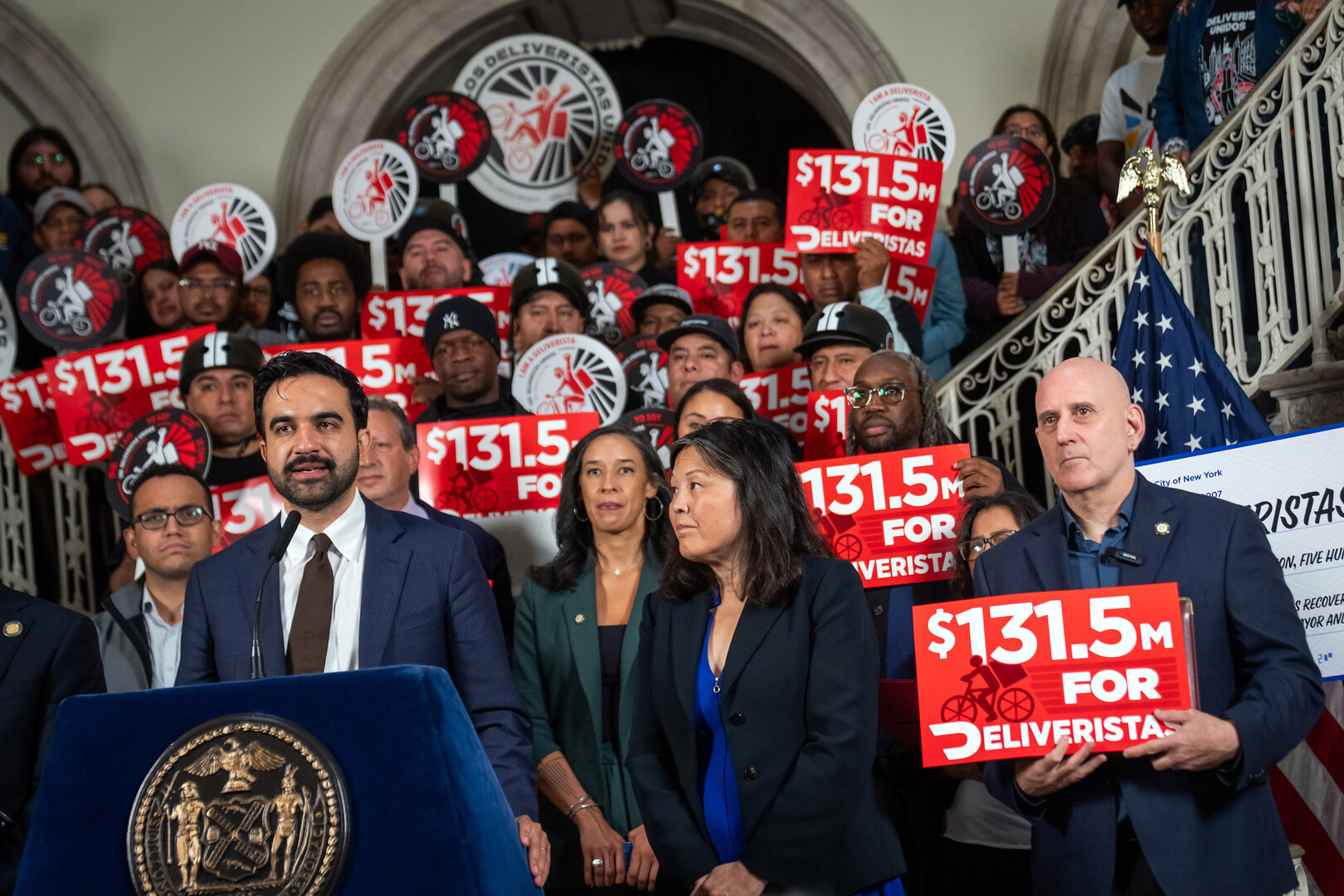
Mamdani, Deputy Mayor for Economic Justice Julie Su and Department of Consumer and Worker Protection (DCWP) Commissioner Samuel A.A. Levine announce a historic $131.5 million enforcement action against DoorDash for systematic violations of New York C
DoorDash has reached a $131.5 million settlement with New York City following an investigation into payments to the company's delivery workers. More than $115 million will be distributed to over 260,000 workers who experienced underpayments, late payments or other minimum-pay violations, while more than $16 million will go toward civil penalties and costs. The agreement also establishes a three-year monitoring system requiring DoorDash to provide detailed monthly data to the city's Department of Consumer and Worker Protection. Workers will also be able to share trip and earnings information directly with the city through new technology being developed with outside partners. Eligible workers are expected to begin receiving settlement payments this fall.
Mayor Mamdani Wins Record $131.5 Million From DoorDash for Delivery Workers
Largest Worker Settlement in NYC History
Largest Settlement for Delivery Workers in American Municipal History
Relief for More Than 260,000 Workers, Stronger Protections Against Unemployment
NEW YORK, NY — Today, Mayor Zohran Kwame Mamdani, Deputy Mayor for Economic Justice Julie Su and Department of Consumer and Worker Protection (DCWP) Commissioner Samuel A.A. Levine announced a historic $131.5 million enforcement action against DoorDash for systematic violations of New York City's Delivery Worker Laws.
The settlement will deliver more than $115 million directly to delivery workers and more than $16 million in civil penalties and costs. It will provide relief to more than 260,000 workers who were underpaid by DoorDash, including workers who were not paid at all or were paid late for work they had already performed.
This is the largest worker settlement in New York City history and the largest settlement involving food delivery workers in the United States.
“When a worker earns a wage, they deserve to be paid that wage — not tomorrow, not after a lawsuit, but on time and in full,” said Mayor Zohran Kwame Mamdani. “DoorDash underpaid more than 260,000 workers, and today we are getting that money back. This is what it looks like when City government stands with working people: We find the violations, we enforce the law and we make sure workers get what they’re owed. No corporation is above the law, and this administration will keep fighting until every worker gets the pay and protections they deserve.”
“The size of this settlement shows the damage done to workers by wage theft. But it also shows that enforcement matters. And in this administration, if you steal workers’ wages, it’s not enough to just pay what you should have paid in the first place. After this, DoorDash workers will also have the power to protect their rights going forward through the new compliance monitoring program,” said Deputy Mayor for Economic Justice Julie Su. “We know that giving workers power in the workplace to protect themselves is critical and this settlement does just that.”
The action builds on the Mamdani administration’s broader effort to vigorously enforce the laws that protect delivery workers. The administration has already secured more than $104 million in additional tips and $725 million in increased wages for delivery workers since January.
“Today, New York City’s delivery workers are showing that opaque algorithms will not have the final word when it comes to how much they are paid for the hard work they do,” said DCWP Commissioner Samuel A.A. Levine. “With this record-breaking settlement and innovative compliance monitoring strategy, the Mamdani administration is demonstrating what it looks like to build an economy that puts working people first.”
The settlement is about more than recovering money that workers are owed. It also puts in place a new monitoring system ensuring DoorDash follows the law going forward – one that gives workers a direct role in identifying violations and gives the City data it needs to act quickly.
DCWP is partnering with Workers Justice Project and the Workers’ Algorithm Observatory to develop software that will allow workers to share their DoorDash trip and earnings data directly with the agency. The new worker-driven compliance system will give DCWP an independent way to identify underpayment and other violations rather than waiting for workers to discover problems after they have occurred.
The effort will be led by DCWP’s new Research and Analytics Division, which uses data science, technology and economic analysis to strengthen the City’s ability to uncover corporate violations and get relief to New Yorkers.
Workers will begin receiving payments this fall. More information is available at nyc.gov/DoorDash.
Details of the Case
DCWP’s citywide investigation began after dozens of workers reported that DoorDash had failed to pay them or had paid them late for work they had performed. Workers Justice Project helped many of these workers file complaints with DCWP.
The agency then expanded the investigation, using detailed pay data to identify additional violations of the City’s Minimum Pay Rate. DCWP found that DoorDash failed to pay thousands of workers at all for work they had performed and failed to pay thousands more on time. These workers will receive compensation calculated at approximately 200% of the amount they were underpaid.
For example, a worker who was owed $1,000 but received no payment will receive $3,000. A worker who was paid $1,000 later than allowed under the law will receive $2,000.
DCWP also found that DoorDash violated the Minimum Pay Rate. Although DoorDash increased hourly pay to the Minimum Pay Rate in December 2023, the company excluded several categories of trip time and on-call time when calculating compensable time.
DCWP will allocate relief to workers who experienced Minimum Pay Rate violations proportionately based on trip time.
As part of the investigation, DCWP obtained terabytes of data from DoorDash, including billions of rows documenting the company’s treatment of delivery workers. DCWP’s Research and Analytics Division analyzed the data to identify more than 152 million individual payment transactions and 110 million working hours connected to the investigation.
A New Model for Compliance
The settlement does more than compensate for past violations. It establishes a worker-driven compliance monitoring program designed to help the City identify and address violations quickly.
Government enforcement can take time, while workers experience violations in real time. The new program will allow DCWP to monitor DoorDash’s compliance with requirements governing minimum pay, maximum trip distances, trip disclosures, pay transparency and tip transparency.
- Monthly Data Reports: DoorDash must submit detailed data reports to DCWP every month for three years. The agency will use those reports to audit the company’s compliance with the law and the terms of the settlement.
- Worker-driven Data Collection: Workers Justice Project and the Workers’ Algorithm Observatory will develop software that allows workers to capture the information DoorDash presents to them about their trips and pay and share that information with City government. Workers Justice Project will conduct outreach to workers about the technology and their rights under City law.
- The New York Community Trust will issue grants to both organizations to support the collaboration throughout the three-year monitoring period. DoorDash is prohibited from preventing or penalizing workers for using the tool.
- Software Updates: DoorDash will be required to make software updates to prevent the company from offering a delivery to a worker in New York City unless that worker’s time is being recorded as compensable on-call time or trip time. The updates will also provide workers with additional information about their work time and pay and ensure DoorDash complies with the Minimum Pay Rule for “batched” trips, ending the unlawful practice of paying a lower rate for certain legs of a trip.
- Internal Controls: DoorDash must adopt internal controls to address the problems that led to violations and prevent future violations. The company must preserve records demonstrating compliance.
- Internal Compliance Monitor: DoorDash’s internal Compliance Monitor will oversee all aspects of the company’s compliance with the settlement. The monitor must document instances of noncompliance, the company’s response and how each issue was resolved. The monitor must also submit an annual report and sworn statement to DCWP certifying compliance with each requirement of the settlement and disclosing and correcting any instances of noncompliance.
About the Minimum Pay Rate
Since DCWP began enforcing the Minimum Pay Rate in December 2023, pay for food delivery workers has increased substantially alongside consumer demand.
The Minimum Pay Rate is adjusted annually for inflation and is currently $22.13 per hour, excluding tips.
How Workers Will Receive Relief
Workers do not need to file a claim or submit evidence to receive payment. DCWP has identified all individuals owed money through its analysis of DoorDash’s records.
In late October, DCWP’s Settlement Administrator will send personalized emails to each worker who experienced an underpayment from April 22, 2022 to June 28, 2026. Emails will be sent to the last email address the worker used with DoorDash and will state the amount the worker is owed.
Workers will be able to choose between an electronic payment and a check by mail. Workers who do not make a selection will receive a check at their last-known address.
A hotline will be available beginning at the end of September for workers with questions or who need to update their email address.
A second round of payments will be made to a small group of DoorDash workers in early 2027 because DoorDash is still correcting elements of the compensable-time calculation logic that caused additional underpayments. This issue may affect workers using DashLink who are entitled to the Minimum Pay Rate.
Delivery workers who believe their rights are being violated can file a complaint with DCWP at nyc.gov/workers.
“Props to Mayor Mamdani, Deputy Mayor Su, Commissioner Sam Levine, and the great team at DCWP on delivering this historic $131.5 million win for delivery workers,” said Brad Lander, former New York City Comptroller and Council Member. “When we passed the Minimum Pay Rate law in 2021, inspired by the organizing of Workers Justice Project, we knew it would take diligent, creative, aggressive enforcement. The Mamdani Administration is showing powerfully what it looks like to govern on behalf of workers.”
“This settlement reflects a tremendous amount of work and advocacy on behalf of workers, and I am proud to stand with Mayor Mamdani and Commissioner Levine as we put all app-based companies on notice that flouting New York City’s laws has consequences, and that this City will make sure workers get their due,” said Majority Leader Shaun Abreu. “This record-breaking enforcement action puts more money back in the pockets of workers who earned it and were owed it, and that will make a real difference for working-class families across our city. I was proud to sponsor and pass the tipping bills that have brought more than $104 million in additional tips to delivery workers. I look forward to our continued partnership to make sure delivery workers get every cent they’ve earned.”
“Amidst a cost of living crisis, delivery workers deserve to rest assured that work completed means compensation earned,” said Council Member and Consumer and Worker Protection Chair Harvey Epstein. “DoorDash must be held accountable for violating minimum wage laws, and withholding wages entirely for hours of work New Yorkers performed over the course of weeks or even months. I commend the Mayor and the Department of Consumer and Worker Protection for implementing systems to empower workers, particularly through partnership with the Workers Justice Project that will allow delivery workers to report their deliveries and pay data directly with DCWP. By increasing transparency between workers and the government, we can ensure robust support for workers against companies who take advantage of them.”
“DoorDash thought they could shortchange their workers and get away with it. Not on our watch,” said Council Member Sandy Nurse. “As DoorDash pulls in record profits, the workers who make them rich are entitled to their fair share. I commend this administration on achieving this historic settlement for workers.”
“For a long time, our deliveristas have gotten the short end of the stick when it comes to their wages,” said Council Member Jennifer Gutiérrez. “Having complex systems to navigate, while also trying to make ends meet, doesn’t always allow these low-wage workers to seek justice for the compensation they deserve from big corporations. I’m happy that the Mamdani administration and DCWP led this effort, making it clear that workers and their livelihoods are paramount.”
"Congratulations to DCWP for holding delivery apps accountable and recovering millions of dollars owed to workers," said Council Member Gale A. Brewer. "I salute the Workers Justice Project for its strong and focused advocacy on behalf of Deliveristas and other low-wage immigrant workers, and the Deliveristas who organized and spoke up for fair treatment. This settlement shows what strong enforcement and persistent advocacy can accomplish.”
“This historic settlement is a major victory for thousands of Deliveristas across New York City who have been organizing for basic rights and building their own union, Los Deliveristas Unidos,” said Ligia Guallpa, Executive Director of Workers’ Justice Project. “For too long, DoorDash treated workers as disposable—stealing their wages and deactivating them, leaving families without the income they rely on. This settlement puts money back in workers’ pockets and holds DoorDash accountable. We are grateful to DCWP for delivering this historic settlement and standing with Deliveristas in this fight. We celebrate this victory, but the fight continues: we will keep organizing for job security, safer working conditions, higher pay and respect.”
“For many years, we delivery workers have been out here every day, working more than 80 hours a week, delivering food and medicine to keep New York City moving,” said Rosendo Tacam, delivery worker and leader of Los Deliveristas Unidos and member of Workers’ Justice Project. “I gave DoorDash everything I had, and then they deactivated me and didn’t pay me for my last week of work. I felt angry and disrespected. When I joined Los Deliveristas Unidos, I realized I was not alone. I filed my complaint with DCWP because I knew we had to speak up. Today, seeing delivery workers get justice is proof that when we organize, we can make companies respect us as the essential workers we were—and continue to be—for our city. Thank you to NYC DCWP for standing with us and defending our rights. We will keep fighting for everything we deserve, because we are the ones delivering what New Yorkers need—rain, snow or shine.”
“We’re glad to serve as an independent check on what platforms report,” said Andrés Monroy-Hernández, founding member of the Workers’ Algorithm Observatory and Associate Professor of Computer Science at Princeton University. “The people doing the work are often the best source of evidence about how these systems actually operate.”
“The New York Community Trust is honored to provide the stewardship, oversight and grantmaking infrastructure needed to ensure these funds are managed responsibly and deployed effectively to benefit the city’s delivery workers,” said Carrie Trowbridge, Interim President and General Counsel of The New York Community Trust. “This initiative highlights the important role that community foundations can play in helping agencies translate settlement recoveries into lasting public benefit.”
DCWP’s lead data scientists on the case include Deputy Commissioner of Research and Analytics Sam Krinsky, Director of Data Science Elizabeth Major, Senior Data Scientist Te Du, Data Scientist Carolyn Liu, Labor Economist Michael Papadopoulos, and postdoctoral researcher Samantha Dalal of the Workers’ Algorithm Observatory. DCWP’s lead attorneys on the case include Deputy Commissioner of the Office of Labor Policy & Standards Elizabeth Wagoner, Investigations Manager Alex Moran, Supervising Investigator Chester Hawkins, and Investigator Brittnee Palusevic.