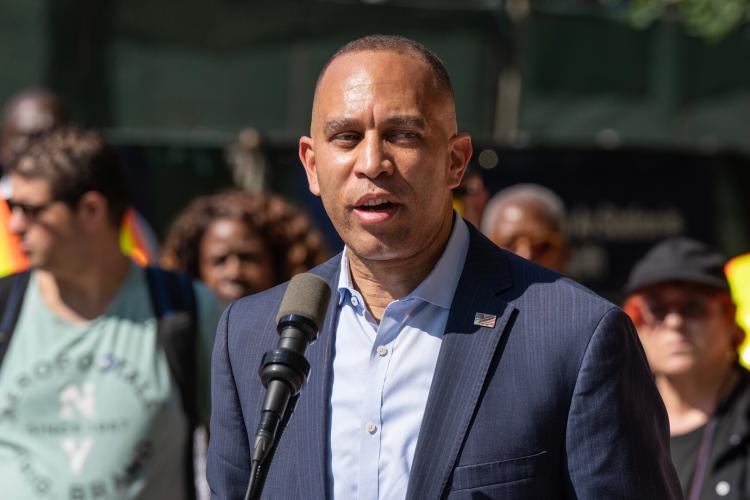
Assemblywoman Rodneyse Bichotte Hermelyn
AP Seth Wenig
Assemblymember Rodneyse Bichotte Hermelyn speaks during the New York State Democratic Convention in New York, Thursday, Feb. 17, 2022. (AP Photo/Seth Wenig)
As Brooklyn Democrats battle over proposed party rule changes, the outrage may be overshadowing a basic political reality: Rodneyse Bichotte Hermelyn found a strategic opening, proposed a change and put it up for a vote. Her opponents don't have to like the move, but they may have to respect it.
You May Not Like Bichotte Hermelyn’s Move, But This Is Politics
By Vernon Jones | CEO JIG Media | Lifelong Brooklynite
There is an uproar inside the Brooklyn Democratic Party over proposed rule changes introduced under Kings County Democratic Party Chair Rodneyse Bichotte Hermelyn. Her opponents have called the proposal a power grab and argue that it could undermine the results of June’s district leader elections, which shifted the balance of power inside the county organization. Some elected officials and reform-oriented Democrats have gone even further, portraying the move as fundamentally undemocratic.
But there is another way to look at what is happening. Bichotte Hermelyn has not declared herself the winner of the next county leadership election or unilaterally rewritten the party rules. She has proposed changes that must still go through the party's process and receive enough votes to take effect. If she doesn't have the votes, the proposals fail and nothing changes. It’s as simple as that.
To give this some context, Bichotte Hermelyn’s proposal would expand the group of party officials who can vote for the Brooklyn Democratic Party’s county leader, rather than leaving that decision primarily in the hands of the 42 district leaders. That larger voting body could significantly change the political math in the upcoming leadership contest.
There are legitimate questions about the timing of the proposals and whether the current party leadership should make such consequential changes before newly elected district leaders assume their roles. Opponents, mostly members of New Kings Democrats, have already turned to the courts to challenge the process, and today, the court rejected their application.
Politics Is About Power — Including the Rules
Let's acknowledge what everyone can see: these proposed changes could benefit Bichotte Hermelyn politically. A coalition of reform-oriented district leaders emerged from the June elections with enough momentum to potentially replace her as county leader. New Kings Democrats and its allies understandably believe those victories should translate into control of the county organization.
Then Bichotte Hermelyn came forward with a proposal that could change the composition of those participating in the leadership decision. Her opponents don't like it, and there is nothing surprising about that. They organized under one political structure, won elections under that structure and expected those victories to give them the power to choose the next county leader.
But not liking a political maneuver does not automatically make the maneuver illegitimate. Politics is about organizing coalitions, understanding rules, counting votes and using the tools available to advance your position. Anyone who has spent meaningful time around politics understands that those things happen every day, whether we like them or not.
Bichotte Hermelyn has argued that her proposal would broaden participation in the Democratic process. Her opponents argue that it would dilute the authority of district leaders elected by Democratic voters and effectively allow the current leadership to change the political equation at the last minute. Both sides should make those arguments, because that is precisely what political debate is supposed to look like.
Reformers Should Understand the Argument for Changing Rules
There is also an irony here that shouldn't be ignored. Organizations such as New Kings Democrats have spent years arguing that the Brooklyn Democratic Party needs reform, greater participation, increased transparency and structural changes. Much of their political identity has been built around challenging an existing party system they believe concentrates too much power in too few hands.
There is nothing inherently wrong with that position. In fact, political organizations should challenge systems they believe need to be improved. But reform cannot mean that changing party rules is democratic when reformers propose the changes and inherently undemocratic when somebody else proposes them.
If New Kings Democrats and its allies eventually take control of the Brooklyn Democratic Party, does anyone seriously believe they will leave every existing rule, procedure and governing structure exactly as they found it? Of course not. They will have an agenda, propose reforms and attempt to use their newly acquired political power to reshape the organization according to their vision of how the Democratic Party should operate. And they should have that right.
But Bichotte Hermelyn has political rights too. If the existing party structure provides a mechanism through which amendments can be proposed and considered, she is entitled to use that mechanism just as her opponents would undoubtedly use it if they controlled the organization.
Proposing a Rule Is Not the Same as Imposing One
This may be the most important distinction in the entire controversy. Bichotte Hermelyn is proposing changes; she is not simply imposing them by decree. Those proposals still have to receive sufficient support from the people authorized to vote on them.
Opponents have already taken their objections to court. But on Monday, a request for a temporary restraining order to stop the process was rejected as premature. That was not a judicial endorsement of Bichotte Hermelyn’s proposals, and opponents could return to court if the rule changes are approved. Still, for now, the political process moves forward: the changes have been proposed, district leaders have the opportunity to vote, and the opponents have the opportunity to defeat them.
But if the process is permissible under the existing rules, then opponents also have a political remedy available to them: convince enough district leaders to vote no. If they succeed, there is no rule change. If they don't, then the proposal passed through the same voting process available for other party business. That's democracy too, even when you don't like the outcome.
Strategy Isn't Automatically an Attack on Democracy
Some Democrats are furious because Bichotte Hermelyn may have discovered a way to change the political equation at precisely the moment her opponents believed they had finally won. Their frustration is understandable. They spent years organizing, challenged incumbents, won district leader races and assembled what they believe is a coalition capable of electing new leadership, which was smart political strategy.
But Bichotte Hermelyn apparently went back to the rulebook and found another potential pathway. If that pathway actually exists within the governing structure of the party, recognizing it and attempting to use it is also political strategy.
The opponents' job now is to stop her. They can make their case publicly, lobby district leaders, organize their supporters, challenge the proposal in court where appropriate and ultimately try to defeat it at the ballot inside the party organization. Those are all legitimate political tools.
What shouldn't happen is for every aggressive political maneuver to automatically be described as an attack on democracy simply because the other side didn't anticipate it.
You Don't Have to Like the Move to Respect It
Personally, I can understand why Bichotte Hermelyn's opponents are angry. If you believe you have spent years building a movement to change the Brooklyn Democratic Party and finally won enough elections to do it, watching the existing leadership propose changes before power transfers would be extremely frustrating.
But politics isn't based on whether the opposing side makes things easy for you.
If Bichotte Hermelyn studied the rules, identified an available option and determined that she could put a proposal before the party for a vote, then she did what experienced political operators do: she looked for a strategic advantage. Her opponents are now responsible for finding their own. They may conclude that changing the structure at this particular moment is unfair, unnecessary or harmful to the party. If enough of them reach that conclusion, they should vote it down, case closed.
It also doesn't mean the courts shouldn't examine legitimate questions about whether the current leadership has the authority to make these changes. If a judge determines that the process is unlawful, that should end the matter.
But absent such a determination, the political argument is surprisingly straightforward. Bichotte Hermelyn has proposed something. Her opponents oppose it. The people empowered to make the decision will have an opportunity to vote.
If the proposal loses, the rules remain the same. If it passes, the rules change. And if reformers eventually take control of the Brooklyn Democratic Party, they will have opportunities to propose changes of their own.
You don't have to like Rodneyse Bichotte Hermelyn's move. You don't have to support it, and you certainly don't have to vote for it. But if she found an opportunity within the existing political process and is attempting to use it to her advantage, there is something to be said for recognizing what it is.
It's politics.
And sometimes the difference between what one side calls a "power grab" and what another side calls "reform" depends on who has the votes.
Bichotte Hermelyn explains her position on video.
To share your opinion or commentary, submit through Voices of NYC