Voices of NYC - Why Continuous Should Be the Most Important Word in Ed
Vatsal Patel
Voices of NYC - Why Continuous Should Be the Most Important Word in Education
This Voices of NYC submission was written by a Brooklyn resident from Park Slope, and reflects the views and opinions of the author.
Why "Continuous" Should Be the Most Important Word in Education
by Vatsal Patel / resident of Park Slope, Brooklyn
This isn't an abstract argument for me. I remember what school actually rewarded me. Everyone around me: teachers, parents, and the whole structure focused on one thing: get good grades, get into a good college, and that will be enough. Nobody explained why learning mattered beyond that transaction, or what it was supposed to do for the community once we had it. I'm in graduate school now and working full-time, and I still don't feel like continuous learning is treated as something that matters, rather it feels like the finish line just moved further out.
I have been seeing where that gap leads. I know highly qualified, experienced people who are unemployed right now, and it eats at them in a specific way: not just financially, but personally. Some fall into real depression over it. Some, tragically, don't survive it. The thought underneath it is almost always some version of: I did everything I was told to do. I got the degree. Why isn't that enough? I also see people years into their careers, working hard, wondering why the promotion never comes, without ever revisiting what they know. Nobody taught them the degree was a starting point, not a deposit that keeps paying out on its own.
That's the real cost of a system that teaches you to finish, not to keep going. It isn't just an efficiency problem: it lands on real people, sometimes devastatingly.
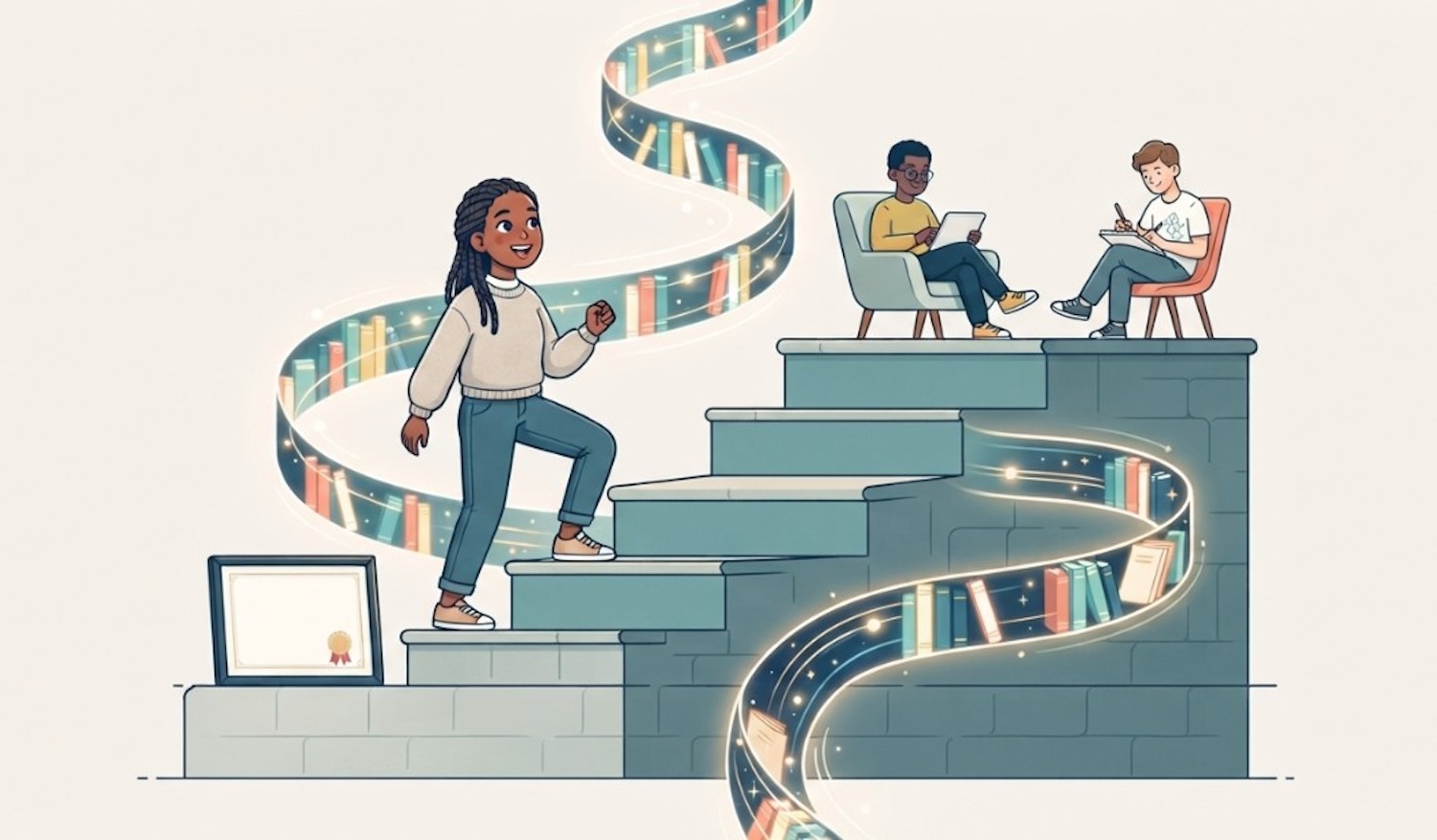
We tend to say education leads to a good life. That's only half true. A degree earned at 22 has a shelf life - industries shift, jobs get automated or redefined, and current knowledge at graduation can go stale by your mid-thirties. What actually leads to a good life isn't education as a one-time achievement. It's continuous education: the ongoing habit of learning that keeps working long after the diploma is framed and hung on a wall. That one word changes everything about how we should think about school.
From a Noun to a Habit
Traditional education is a noun: a thing you get, complete, and hold onto. It has a finish line: a diploma, a certificate, a degree. Continuous education is a verb. It never finishes, and that shift changes what we're actually optimizing for.
If we think of the goal to be a credential, students learn to optimize for the credential: the grade, the test score, the transcript. If the goal is a lifelong habit, we have to optimize for something else, that is, curiosity, tolerance for being a beginner again and again, and a genuine appetite for figuring things out. Compounded over twenty or thirty years, a person who keeps learning ends up somewhere very different from the one who stopped at graduation, even if they started in the same place.
The Gap in the Current System
Our education system is very good at teaching people to complete milestones. It isn't designed to teach people to want to keep learning once the milestones stop being handed out.
This isn't a failure of intent as milestones exist because they're measurable at scale. A system educating millions of students needs some way to sort and credential people, and "did this student fall in love with learning" is nearly impossible to standardize. But that scaling solution has a side effect: it teaches students to chase the proxy, which is the grade, rather than the thing it was meant to represent.
The fix isn't to tear down degrees. A degree still matters as it prepares students for real-world structure and the discipline of consistent work. The fix is to run something alongside that track: a curriculum whose explicit job is building the habit of curiosity, the same way gym class builds the habit of staying active. What could that look like?
- Protected time for self-directed inquiry: a regular block where students go deep on something they choose, graded on the pursuit itself, not the topic. "Genius Hour," modeled loosely on Google's old 20%-time policy, is a small-scale example.
- Explicit instruction in how to learn: the difference between skimming and real understanding, how to sit with confusion instead of reaching for an answer immediately.
- Visible modeling from teachers: adults learning something new and struggling with it openly. Kids absorb behavior more than lectures.
- A separate scorecard for curiosity: grading "did you follow a real question this month" independently from content mastery.
But alongside this, the honest tension is time: every hour spent here is an hour not spent on tested material. That's a real tradeoff schools will have to work out deliberately.
Why This Can't Wait: AI Changes the Stakes
Curiosity has always been built through friction: you get curious about how something works because you're stuck and want to get unstuck. Calculators removed friction from arithmetic. Search engines reduced it further but still required piecing an answer together yourself. AI removes nearly all of it, handing a finished answer in one step, while “assembly" was exactly the part that built the habit of thinking things through.
If a child reaches for AI before ever sitting with the discomfort of being stuck, the habit of curiosity may never form. But not every student will lose out this way: some will use AI as a genuine amplifier. But the split will likely track whether curiosity was already a habit before heavy AI use began, which makes building that habit early more urgent, not less.
This is already playing out, not hypothetical. Before the city had formal policy, individual schools were left to figure it out alone. At one of the Manhattan schools, staff were reportedly holding multiple meetings a week over students misusing AI, until an assistant principal convened his own committee and spent months drafting a policy from scratch. That's the gap in real time: a system not built to instill the underlying habit, scrambling school by school to patch the symptom instead.
The city has since caught up, at least on paper. In March 2026, New York City Public Schools released its first formal AI guidance, built around a "traffic light" framework: some uses banned outright (discipline decisions, grading, IEP and 504 planning), some approved (brainstorming, scheduling, routine communications), and a "yellow" middle tier - including student use for research and creative projects, calling for caution and teacher guidance. The guidance is still openly a first draft, with families and educators invited to weigh in.
That's exactly why this is the right moment to raise the point. A policy governing how AI is used is necessary, but it doesn't answer the deeper question: are we building curiosity underneath it, or just managing a tool sitting on top of a gap that was already there? A rulebook can prevent misuse. It can't manufacture the impulse to think something through before reaching for help. Only a deliberate curriculum for curiosity can do that, and right now it exists as language about "critical thinking" in state frameworks, not as a protected practice most students actually get.
The Groundwork Already Exists - It Just Isn't Universal
I am not proposing a fringe idea from scratch here. Pieces of it already exist in our system. In New York City's new curriculum for Algebra 1, Illustrative Mathematics, is explicitly inquiry-based, where students get a problem first and work toward the method through questioning, rather than being taught a formula and then applying it. A growing number of NYC schools have adopted the International Baccalaureate model, which centers inquiry-driven learning that lets students go deep on a topic and connect it to the world outside the classroom. At the state level, New York's "Portrait of a Graduate" framework already names critical thinking and creativity as competencies every student should leave with.
What's missing isn't the idea, but the universality of it. Whether a student gets exposure to curiosity-first learning depends heavily on which school, track, or subject they land in. There's no equivalent of gym class that guarantees every student, regardless of school or borough, gets dedicated time built around the habit of curiosity itself.
The Question Worth Asking
None of the specifics here: how much class time, what it's graded on, whether it's a standalone subject or woven into every other subject, are ones any single person should decide alone. This is a conversation for educators, parents, and policymakers to have together. But the starting premise is worth stating plainly: a degree prepares students for the structure of adult life. A love of continuous learning is what prepares them for a life that keeps changing after the degree is done. The building blocks such as inquiry-based math, IB schools, and a first attempt at AI guidance already exist in pieces around this city. What's missing is the decision to make curiosity itself a guaranteed part of every student's education, not a matter of which school they happen to attend. That gap will only matter more as AI becomes a permanent fixture in how students learn, and the window to close it is now, not someday.
by Vatsal Patel, resident of Park Slope, Brooklyn
Submit Your Voices of NYC commentary:
Read the Submission Guidelines and give your opinions and ideas a voice.