Teachers collaborating on ai learning
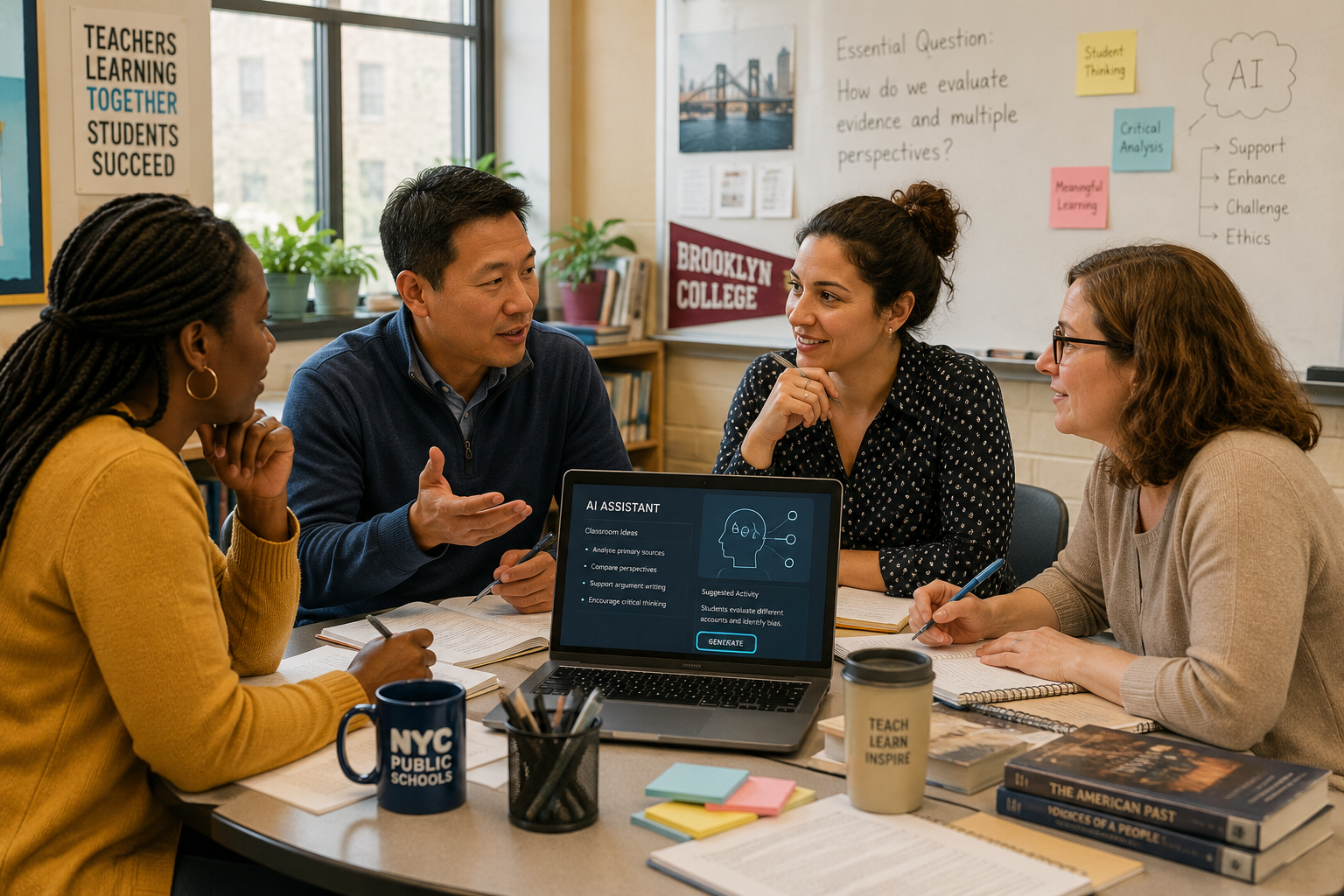
Illustration created with ChatGPT for NYC Newswire.
Teachers collaborating on lesson planning while discussing the role of artificial intelligence in education.
As schools rapidly adopt artificial intelligence tools, the conversation often centers on how students will use them. In this Voices of NYC commentary, Brooklyn College professor Dr. Sonia Murrow argues that the greater challenge is ensuring teachers receive the ongoing support needed to adapt their instruction. Drawing on interviews with New York City educators, she contends that while AI technology is advancing quickly, professional learning has not kept pace. Rather than relying on occasional workshops, she makes the case for sustained collaboration that helps teachers thoughtfully integrate AI while preserving critical thinking and meaningful learning in the classroom.
Editor's Note: This article is part of Voices of NYC, NYC Newswire's opinion and commentary series. The views expressed are those of the author.
The Real AI Divide Isn't Technology. It's Teacher Learning.
School districts across the country are spending millions of dollars to bring artificial intelligence into classrooms. They are purchasing licenses from Microsoft, Google, OpenAI, and a growing list of education technology companies. States are issuing guidance. Districts are launching pilot programs. School leaders are encouraging teachers to experiment.
But one critical investment has received far less attention: teachers.
Public debate about AI in schools has focused largely on students. Will they use it to cheat? Will it improve learning? Will it weaken critical thinking? Those questions matter. But another may prove even more important: How are teachers expected to learn to teach in the age of AI?
New York City offers an important case study—not because its challenges are unique, but because it has invested more heavily than most districts in teacher learning. Through the National Academy for AI Instruction, educators can access AI training, curriculum support, and certification. In many respects, New York has become a national leader in preparing teachers to work with AI.
Yet my interviews with New York City secondary social studies teachers suggest that even these investments expose a larger problem. Nearly four years after generative AI entered classrooms, access to meaningful professional learning remains uneven. Some teachers collaborate regularly with colleagues to experiment with AI and rethink instruction. Others described receiving little more than an emailed policy, a webinar, or a single professional development session before being expected to navigate one of the most significant technological shifts in education largely on their own.
The lesson extends well beyond New York. If one of the nation's best-resourced school systems struggles to create sustained opportunities for teachers to learn together, what does that say about the prevailing model of teacher learning?
One Manhattan history teacher I interviewed illustrates what sustained collaboration can make possible. After months of working with colleagues, experimenting with AI, and redesigning curriculum, he fundamentally changed his teaching. Because AI can instantly generate factual summaries, he now devotes more classroom time to interpreting evidence, evaluating competing claims, and constructing historical arguments. Rather than designing "AI-proof" assignments, he asks students to explain how they used—or deliberately chose not to use—AI. They critique AI-generated responses as they would any historical source, asking whose perspective is represented, what evidence is missing, and whether the conclusions are justified.
His guiding principle is simple: AI may assist teachers, but it should never relieve students of the responsibility to think.
Most of the other teachers I interviewed described a very different experience. They were navigating AI through trial and error, searching online for ideas, and relying on informal conversations with colleagues. Several said AI rarely surfaced in faculty discussions despite its growing presence in students' lives. Their commitment to improving instruction was evident. But no profession should expect its members to navigate transformational change largely alone.
The problem is bigger than AI. It is that schools continue to rely on an outdated model of teacher learning.
For decades, professional development has been built around workshops, conference days, and outside experts. Teachers attend a session, collect materials, return to their classrooms, and are expected to translate broad ideas into daily practice. That model made sense when educational change unfolded gradually. It is poorly suited to a technology that evolves monthly and continually reshapes questions about teaching, assessment, and learning.
Artificial intelligence does not present educators with a fixed body of knowledge that can be mastered in a day. It continually raises new instructional and ethical questions. When does AI deepen learning? When does it replace the intellectual work students must do themselves? How should assignments change? How should assessment change? No workshop can answer those questions once and for all.
Professional learning must become part of the everyday work of schools rather than an event that happens a few times each year.
Teachers need regular time to plan together, examine student work, observe one another's classrooms, test new approaches, and reflect on what they are learning. Universities, technology companies, and consultants can introduce valuable ideas, but they cannot replace the professional communities that develop within schools, where teachers who share students, curriculum, and daily experience build expertise together.
Models already exist. Japan's Lesson Study brings teachers together to plan lessons, observe instruction, and refine practice over time. New York City's Descriptive Review Process similarly engages teachers in examining student work and instructional decisions. Though different in design, both recognize that professional expertise develops through sustained collaboration rather than isolated workshops.
Many teachers remain appropriately skeptical of AI. They worry that students will rely on it before they have learned to read closely, write clearly, or think independently. Those concerns deserve serious consideration. But skepticism is not an argument for leaving teachers to figure AI out alone.
New York City's experience demonstrates that the challenge is not simply expanding access to AI training. It is rethinking how teachers learn. As districts invest heavily in AI tools, they should invest just as seriously in the collaborative structures that allow teachers to determine when AI belongs in the classroom—and when it does not.
The next educational divide will not be between schools with AI and those without. It will be between schools that treat teacher learning as ongoing professional work and those that continue to rely on a professional development model designed for a different era.
About the author:
Sonia Murrow is a professor of Social Studies Education and education history at Brooklyn College, CUNY. She is a certified social studies teacher and taught for the NYC Department of Education before earning her doctorate.
Editor's Note: Voices of NYC is NYC Newswire's opinion and commentary series featuring perspectives from New Yorkers on issues affecting New York City. The opinions expressed are those of the author and do not necessarily reflect the views of NYC Newswire or JIG Media.
Share Your Voice
NYC Newswire welcomes submissions from educators, community leaders, business owners, advocates, students, public officials, and residents who want to contribute thoughtful commentary on issues affecting New York City. Submissions should present original ideas, personal insight, or informed analysis and may be edited for clarity, style, and length.
To submit a commentary for consideration, email your article to [email protected] with a short author biography and any relevant credentials. Publication is at the discretion of NYC Newswire's editorial team. See the Voices of NYC Submission Guidelines.